Quick answer
Pharmacy health screening events, blood pressure checks, immunization clinics, and disease awareness days, help independent pharmacies build community trust. They also drive real foot traffic. Partnering with existing local organizations is usually the fastest way to launch one successfully. Even a modest, well-run event builds lasting goodwill and repeat visibility over time.
Pharmacy health screening events turn your pharmacy from a place people visit only when they need a prescription filled into a destination people visit to stay healthy. That distinction matters more than it sounds, since it is exactly the kind of positioning a national chain's standardized model struggles to replicate at the local level. It is also one of the few marketing investments that improves patient health directly while it builds your business.
WSPC sees health events as one of the highest-leverage tactics available to independents specifically because they combine two things at once: genuine patient care and real, organic marketing. Nearly 19,000 independent pharmacies compete for the same patients nationally, employing more than 200,000 people according to Pharmacy Times' coverage of NCPA's 2024 convention, and community visibility from a well-run event is a differentiator a chain cannot easily copy. This guide walks through why these events work, what to host, and how to actually follow through afterward.
Pharmacy health screening events work well for independents because they position the pharmacy as a healthcare destination rather than just a dispensing counter, reinforcing exactly the trust advantage independents already hold with patients.
Pharmacy Health Screening Events: By the Numbers
Pharmacy Times has reported that offering services like immunizations, point-of-care testing, and health screenings brands a pharmacy as a healthcare destination, and combined with existing patient relationships, creates a very strong offering competitors cannot easily replicate. That combination, clinical service plus relationship, is precisely what a chain's higher-volume, lower-personalization model finds hardest to match.
There is also a perception dimension worth noting. Pharmacy Times has separately cited Accenture data showing 63% of consumers believe independent pharmacies are more innovative than large chains. A visible, well-run health event is one of the clearest ways to make that innovative reputation tangible. It gives someone who has not yet set foot in your store a real reason to notice you.
None of these outcomes require a large event. Even a modest, well-run screening reaches people who drive past your pharmacy every day without ever stepping inside. A single positive first impression from a health event tends to stick far longer than an ad they scrolled past online. Budget is rarely the limiting factor here. Time and planning are, and both are fully within an owner's control.
Consumers See Independents as More Innovative
Of consumers believe independent pharmacies are more innovative than large chains, per Accenture data cited by Pharmacy Times. A visible health event is how that reputation becomes tangible.
Community visibility is a real growth lever
WSPC members get shared training and group resources built for owners running these exact kinds of programs.
Explore Member Resources →Community proximity makes health events effective because most people already live within a short drive of a community pharmacy, according to NACDS and NCPA, which means attendance rarely requires a real trip out of someone's way.
Being physically close to thousands of potential patients only helps if they notice you. Most Americans live within a few miles of a community pharmacy, per NACDS and NCPA data, but proximity alone does not create awareness. A visible event, a sign near the entrance, a folding table on a Saturday, converts that latent proximity into an actual first visit. The pharmacy across town cannot compete with the one someone already drives past twice a week.
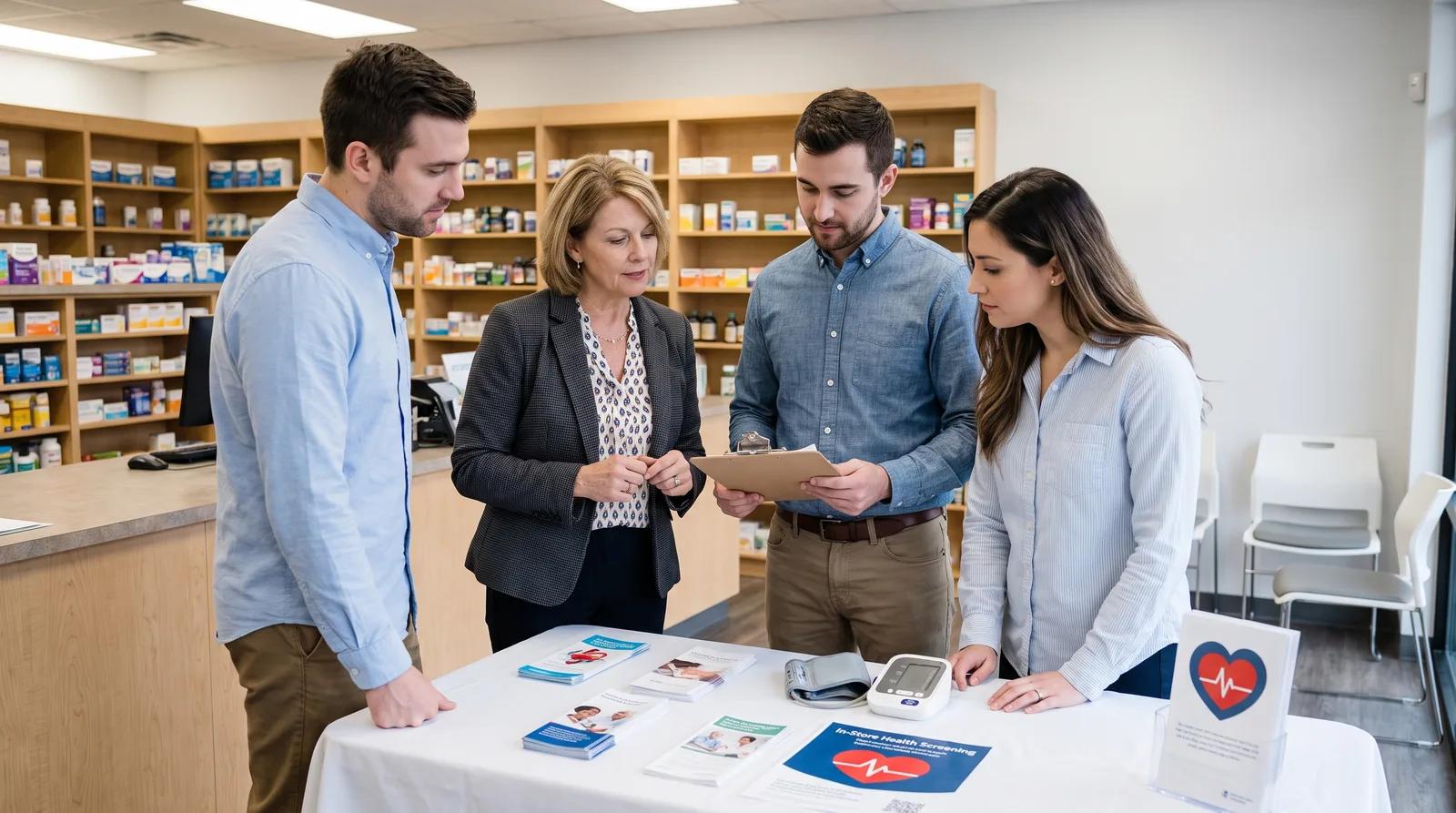
A pharmacy should consider hosting blood pressure checks, immunization clinics, medication reviews, and point-of-care testing events, since these directly showcase clinical services many patients may not even realize their pharmacy already offers.
Start with services you already provide, and simply make them more visible and accessible for a set window of time. A flu shot clinic on a Saturday morning, a blood pressure screening table near your entrance for a week, or a medication disposal day are all low-complexity events. Each one builds on infrastructure your pharmacy already has in place. None of these require new licensure or major investment. They require deciding to make an existing capability visible and available for a defined window rather than only on request.
| Event Type | Typical Effort Level |
|---|---|
| Blood pressure screening | Low; can run during normal hours |
| Immunization clinic | Moderate; needs scheduling and staffing |
| Medication disposal day | Low; a single scheduled day, minimal supplies |
| Point-of-care testing (e.g., cholesterol, A1C) | Moderate; requires CLIA-waived testing supplies and training |
Resist the urge to launch something elaborate on your first attempt. A single well-run blood pressure screening table, staffed for a few hours on a busy Saturday, teaches you more about what your community actually responds to than an ambitious multi-service health fair that stretches your team too thin to execute well.
You need enough staff coverage to run the event without leaving your regular dispensing operation short-handed. You also need basic supplies and any required licensure documentation confirmed in advance for the specific screening or clinical service offered.
Plan staffing first, since an understaffed event creates two problems at once: a frustrated line of attendees and a pharmacy counter falling behind on routine business. Consider whether the event needs a pharmacist specifically, or whether a trained technician can handle parts of it under appropriate supervision. Confirm any state-specific requirements for the service you are offering well ahead of the date, since scrambling to verify compliance the morning of an event is a preventable stress you can avoid with a little lead time. A brief written checklist covering staffing, supplies, and compliance sign-off makes the whole process repeatable for future events too.
It also helps to designate one person as the event lead well before the day itself, someone responsible for supplies, sign-in, and troubleshooting on site. Without a clear owner, small logistical issues tend to fall through the cracks precisely when your team is busiest juggling both the event and normal operations.
A pharmacy can use disease awareness months as a built-in calendar, planning a relevant screening or education event around each observance instead of trying to invent a reason to engage the community from scratch every time.
Drug Topics has noted that months like American Heart Month in February and Mental Health Awareness Month in May give pharmacies sustained opportunities to connect with the community. They also help educate patients on important, sometimes underrecognized health issues. These recurring dates make planning easier since you can anticipate them a year in advance rather than reacting to a one-off opportunity.
This calendar approach also helps with staffing and budgeting, since you can plan ahead rather than reacting to a sudden idea with only a few weeks of lead time. By the second year of running a disease-awareness calendar, most of the planning work is simply refinement, not reinvention, freeing up time to focus on execution instead of scrambling to decide what to run next.
FEBRUARY
American Heart Month
MAY
Mental Health Awareness Month
AUGUST
Back-to-School Immunizations
NOVEMBER
Diabetes Awareness Month
A starting template. Adjust to the observances most relevant to your own patient population.
A pharmacy should prioritize events that match its actual patient population's needs, rather than copying whatever a nearby pharmacy or chain happens to be running. Relevance drives turnout far more reliably than novelty does.
A pharmacy serving a large senior population will get more value from a blood pressure or diabetes screening than a back-to-school immunization push. A pharmacy near a school district might see the opposite result. Look at your own patient mix, common chronic conditions, typical age range, seasonal patterns, before committing to a calendar of events. Let that data guide the choice rather than assuming one format works everywhere equally well. A quick look at your top dispensed medication categories often tells you more about which screening to prioritize than any generic industry list could.
Yes, a pharmacy should partner with existing local organizations whenever possible. Senior centers, churches, and civic groups often already have programming, audiences, and trust that a pharmacy can add real value to rather than duplicate from scratch.
Drug Topics quoted a pharmacy marketing specialist making this point directly: independent pharmacies do not have to reinvent the wheel. Community organizations are frequently already running events a pharmacy can simply join. Partnering saves time, and it also lends your pharmacy credibility by association with an organization the community already trusts. It is a faster path to visibility than building an entirely new event from the ground up.
Start with a short, direct conversation rather than a formal proposal. Most community organizations are receptive to a local pharmacy offering a free or low-cost health service at an event they are already running, since it adds real value to their attendees without costing them anything. Approach it as a genuine offer to help, not a sales pitch, and the partnership tends to follow naturally.
A Faster Path to a Local Health Event
1. Identify a local org
A senior center, church, or civic group with an existing audience.
2. Offer a free service
A screening or clinical service that adds value to their event.
3. Borrow their trust
Your pharmacy gains credibility by association with an audience that already trusts the host.
Health events can support long-term adherence when a screening becomes a doorway into sync or clinical follow-up, not just a one-time interaction. A blood pressure check that ends without a next step is goodwill; one that leads to enrollment in a program is a new patient relationship.
Appointment-based models and medication synchronization have been associated with improved adherence, according to the APhA Foundation, which makes an event a natural entry point rather than an endpoint. Someone who stops by for a free screening is already engaged. Asking if they would like their refills synced, or flagging them for a follow-up consultation, converts that one moment of attention into an ongoing relationship. Clinically integrated networks such as CPESN connect community pharmacies to value-based and payer programs, according to CPESN USA, so the clinical relationship an event starts can eventually become billable, outcomes-linked work rather than just community goodwill.
Related: Turning a one-time health event into an ongoing patient relationship is where medication sync earns its keep. See more Medication Adherence & Sync coverage →
Related: Networks like CPESN are turning routine clinical touchpoints into recognized, value-based revenue for independents. Explore Clinical & Value-Based Care coverage →
A pharmacy should follow up after a health event by tracking how many new patients it generated and gathering informal feedback. Treat each event as a repeatable, improvable process rather than a one-time effort that gets forgotten once the tables are packed away.
Simple tracking works fine here: a sign-in sheet, a quick tally of screenings performed, or asking attendees how they heard about the event. Compare this data across events over a year, and you will start to see which formats and partnerships actually convert into new patients versus which ones mostly generate goodwill without much measurable follow-through. Both outcomes have value, but knowing the difference helps you plan next year's calendar more effectively.
Do not skip this step even for a small event. The habit of tracking, however informally, is what separates a pharmacy that gets steadily better at community events from one that runs the same event every year without ever learning which parts actually worked.
You don't have to plan this alone
WSPC members get shared training, group purchasing power, and a network of independent owners running these same programs.
Become a Member →Pharmacy health screening events are one of the few marketing tactics that build genuine community trust and real clinical value at the same time. Start small, one blood pressure clinic, one flu shot event, partnered with an organization that already has an audience, and build from there. Over time, these events do more to position your pharmacy as a healthcare destination than any single ad campaign could, and each one gets easier to run once the first is behind you.
This article is general educational information for independent pharmacy owners and operators and is not legal, financial, tax, or regulatory advice. Verify current requirements and consult qualified professionals before acting. WSPC provides resources and advocacy for independent community pharmacies.
Ready to grow your pharmacy with the right support behind you?
WSPC members get group purchasing power, shared training resources, and an active advocacy voice for independent pharmacy.
Become a Member →Have questions about growing your pharmacy?
Contact WSPC →Sources
Written by
WSPC
Independent Pharmacy Cooperative · WSPC
WSPC is a member-owned cooperative that helps independent community pharmacies lower their cost of goods, grow revenue, and stay competitive through group purchasing, business analytics, clinical programs, and advocacy.
Was this article helpful?
A pharmacy health screening event is an in-store or community gathering where a pharmacy offers services like blood pressure checks, immunizations, or point-of-care testing, often tied to a broader disease awareness theme.
Yes. Health screenings and immunization events build visibility and trust with people who may not currently be patients, positioning the pharmacy as a healthcare destination rather than simply a place to pick up medication.
Look to senior centers, churches, civic groups, and local nonprofits that may already run related programming. Partnering with an existing initiative is usually faster than launching a standalone event from scratch.
Disease awareness months are recurring calendar observances, like American Heart Month in February, that give a pharmacy a built-in, recognizable reason to host a relevant screening or education event each year.
No. A modest, well-run screening or clinic still builds real goodwill and visibility. Consistency over time matters more than the size of any single event, and a small recurring event often builds more lasting trust than one large one-time push.
Follow up with attendees where appropriate, track how many new patients the event generated, and note what worked so the next event can build on it rather than starting from scratch each time.
Yes. Most Americans live within a few miles of a community pharmacy, according to NACDS and NCPA, which lowers the barrier to attending a local event compared to traveling somewhere unfamiliar.
Yes. A screening can lead into medication synchronization or clinical follow-up, and appointment-based sync models are associated with improved adherence, according to the APhA Foundation, turning a one-time visit into ongoing care.
63% of consumers believe independent pharmacies are more innovative than large chains, according to Accenture data cited by Pharmacy Times, and a visible health event is one of the clearest ways to make that reputation tangible.
Pharmacy vaccine marketing turns immunization clinics into a genuine patient acquisition engine, not just a seasonal service, for independent owners.
Pharmacy online reviews shape whether a new patient chooses your pharmacy or a competitor. Here is how to earn more reviews and respond well to every one.
A pharmacy patient loyalty program built around health actions, not just spending, helps independents build lasting relationships chains cannot copy.
WSPC gives you the buying power, the contracts, and the people to protect it.